XRP is not a stablecoin
XRP is not a stablecoin because it does not promise, target, or mechanically defend a fixed value such as 1 USD. XRP is a market-priced crypto asset used on the XRP Ledger, while stablecoins are built for peg behavior and route-sensitive transfers; before moving assets between exchanges and wallets, check this guide on how to send crypto on the correct networek so the asset and network are not mixed up. XRP’s price can move up or down like other traded crypto assets, which is exactly the behavior stablecoins are built to avoid.
A stablecoin is a digital asset designed to maintain a stable value against another asset. That reference can be the U.S. dollar, a euro, gold, or a basket of assets. The boring part is the point: the token should behave more like digital cash than a speculative chart with commitment issues.
Ripple’s stablecoin documentation describes a stablecoin as a digital asset designed to maintain a stable value tied to a traditional currency such as the U.S. dollar or euro, and describes RLUSD as a U.S. dollar-backed stablecoin. XRP does not fit that description. It is useful in a different way: Ripple’s XRP overview describes XRP as the native asset of the XRP Ledger, where it facilitates transactions, helps protect the ledger from spam, and can bridge currencies in XRP Ledger payment flows.
The most practical answer is simple. If someone says, “XRP is basically a stablecoin because it is used for payments,” that is mixing up payment utility with price stability. A delivery truck can move cash; it does not become cash. Crypto has many such category accidents, usually wearing a confident Twitter avatar.
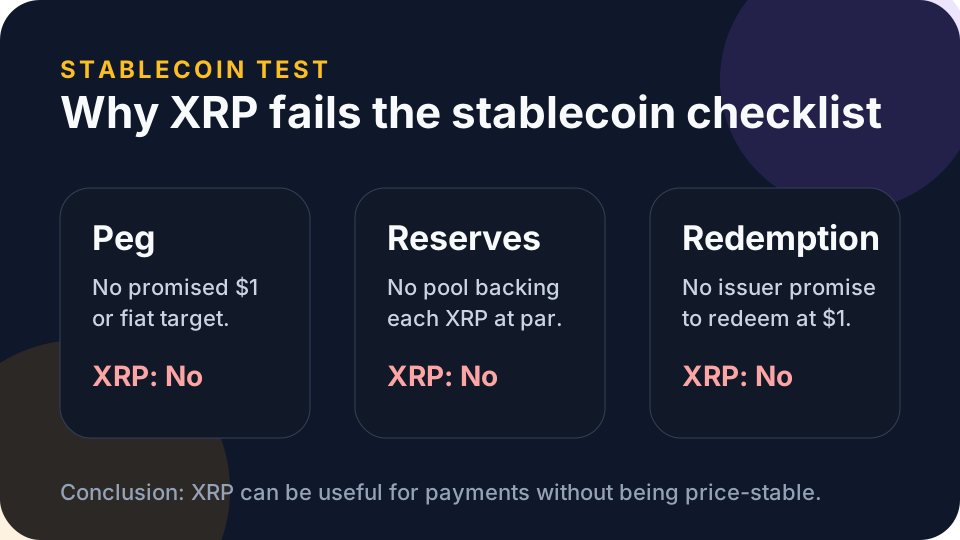
| Stablecoin test | XRP | Typical fiat stablecoin |
|---|---|---|
| Target price | No fixed dollar target. | Usually targets 1 USD or another fiat unit. |
| Reserve backing | No reserve pool promises redemption for one dollar. | Often backed by cash, Treasury bills, or similar assets. |
| Redemption right | No general right to redeem XRP from an issuer for one dollar. | Issuer rules may allow redemption at par for eligible users. |
| Market behavior | Price floats with supply, demand, liquidity, news, and risk appetite. | Should trade close to its peg, though de-pegs can happen. |
| Primary role | Native network asset and bridge asset. | Dollar-like settlement, trading, treasury, or payment unit. |
Why people confuse XRP with stablecoins
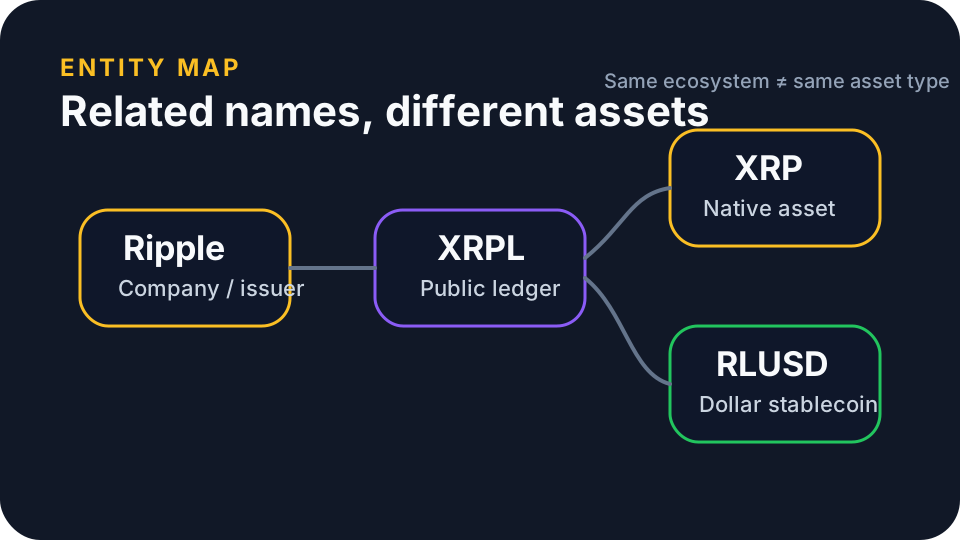
The confusion is understandable, but it comes from overlapping names and use cases. Ripple is a company. XRP is a crypto asset. The XRP Ledger is the public blockchain. RLUSD is Ripple’s dollar-backed stablecoin. Put them in one sentence and the average beginner starts looking for an exit sign.
Ripple’s own RLUSD page says RLUSD is designed to maintain a constant value of one U.S. dollar and is backed one-to-one by cash deposits, U.S. Treasuries, and cash equivalents. The same page separates XRP from RLUSD: XRP is the native cryptocurrency of the XRP Ledger, while RLUSD is a dollar-backed stablecoin from Ripple. That distinction is the spine of the whole answer.
Another source of confusion is the phrase “bridge asset.” XRP can be used as a bridge between currencies or assets. A bridge asset is not automatically a stable asset. It can be liquid and useful for settlement while still changing price against the dollar.
Payment marketing also blurs categories. Crypto payment pages often talk about fast settlement, low fees, global transfers, and liquidity. Stablecoins can do some of that. XRP can do some of that. Bitcoin, Ethereum, and bank wires can do bits of it too. Use case overlap does not merge asset design.
The exact-match SERP also includes a Reddit thread asking why people call XRP a stable coin instead of a stablecoin issued on XRP. That user-generated result confirms a real confusion pattern: people are not only asking for a definition; they are trying to separate XRP from RLUSD, XRPL issued tokens, and casual social-media shorthand.
What XRP actually is
XRP is the native token of the XRP Ledger. Ripple’s XRP overview describes XRP as the native token of the XRP Ledger, similar in role to ETH on Ethereum or BTC on Bitcoin, and says it facilitates transactions, protects the ledger from spam, and can bridge currencies in the native decentralized exchange.
That network-native role matters. On blockchains, native assets often pay fees or support core ledger mechanics. They do not need a peg to do that job. ETH is not a stablecoin because Ethereum has fees. XRP is not a stablecoin because the XRP Ledger uses it.
The XRP Ledger itself is a public blockchain. XRPL.org describes it as a decentralized public blockchain with a community of businesses and developers, and lists features such as a decentralized exchange, cross-currency payments, payment channels, multi-signing, and token issuance. Those features explain why XRP gets discussed in payment contexts.
None of those features creates a promise that one XRP equals one dollar. The ledger can support stablecoin-like issued assets, but XRP remains XRP. This is the part where labels matter. In crypto, a mislabeled asset is not just a vocabulary problem; it can become a risk-management problem with a wallet address.
Mechanism map
What a stablecoin is
A stablecoin is a crypto asset designed to maintain a relatively stable value against a reference asset. In the U.S. market, that reference is usually the dollar. Ripple’s stablecoin FAQ uses the same basic category test: a digital asset designed to maintain stable value, often tied to a traditional currency such as the U.S. dollar or euro. The design can be fiat-backed, crypto-backed, commodity-backed, or algorithmic, but the common promise is a price target.
For a fiat-backed stablecoin, the issuer typically holds reserves such as bank deposits, Treasury bills, or other cash-equivalent assets. The reserve pool is supposed to support redemption or market confidence. In theory, this is dull. In practice, stablecoin reserve quality is where many financial detectives find their first cigarette butt.
Stablecoins can still break their peg. The name says what the design aims to do, not what nature is legally required to obey. Liquidity shocks, reserve questions, issuer risk, chain congestion, smart contract bugs, and regulatory events can all push a stablecoin away from its target.
That is why the stablecoin label should not be treated as a safety certificate. It is a product category. A well-backed stablecoin, a weakly disclosed stablecoin, and an algorithmic design with a heroic whitepaper can all sit under the same umbrella. Some umbrellas are real. Some are just spreadsheets in a rainstorm.
XRP vs RLUSD: the clean comparison
XRP and RLUSD are separate assets with different jobs. XRP is the XRP Ledger’s native cryptocurrency. RLUSD is Ripple’s U.S. dollar-backed stablecoin. Ripple states that RLUSD is issued on the XRP Ledger and Ethereum, is backed by U.S. dollar deposits, U.S. Treasuries, and cash equivalents, and can be redeemed at par under its terms.
That separation matters for transfers, accounting, taxes, and risk. If a user sends XRP, the recipient receives exposure to XRP’s market price. If a user sends a dollar stablecoin, the recipient expects a dollar-like amount, subject to issuer, chain, and redemption risk.
| Question | XRP | RLUSD |
|---|---|---|
| Is it a stablecoin? | No. | Yes, according to Ripple’s stablecoin documentation. |
| What is it for? | Network utility, fees, liquidity, bridge-asset use, trading. | Dollar-denominated payments, settlement, trading pairs, and on/off-ramp use cases. |
| What sets the price? | Open-market supply and demand. | Dollar peg design, reserves, redemption rules, and market confidence. |
| Main risk | Market volatility and liquidity conditions. | Issuer, reserve, redemption, regulatory, and chain risk. |
| Best mental model | Native crypto asset. | Tokenized dollar claim or dollar-tracking settlement asset. |
Why XRP can still be useful without being stable
XRP can be useful without being stable because settlement utility and price stability are different features. A volatile asset can move quickly. A stable asset can preserve a unit of account. They solve different problems, and pretending they solve the same one is how bad treasury decisions get dressed as innovation.
For traders, XRP volatility may be the point. For a payroll team, volatility is usually a problem. For a developer, XRP may be relevant because of fees and ledger mechanics. For a merchant, a stablecoin may be more useful when invoices are priced in dollars. The right asset depends on the job.
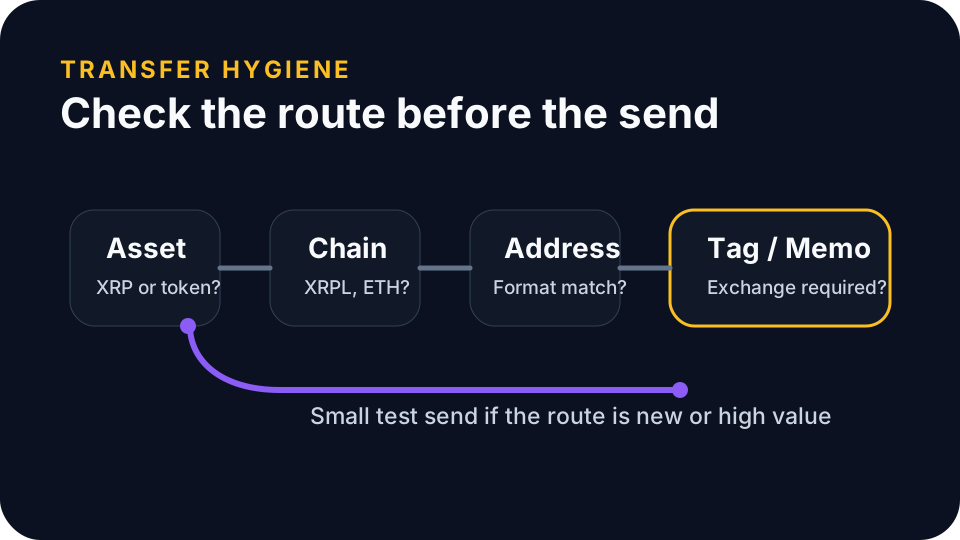
Users should also separate “fast” from “safe.” A transaction can settle quickly and still be sent to the wrong chain, wrong tag, wrong token contract, or wrong recipient. Speed is excellent after you verify the route. Before that, it just helps mistakes arrive earlier.
That is where wallet hygiene matters. When moving assets between exchanges and self-custody wallets, the network selected in the sending interface must match what the receiving wallet supports. Do not assume “XRP,” “XRPL,” “Ethereum,” and “stablecoin” are interchangeable labels. They are not.
How to decide whether you need XRP or a stablecoin
The decision starts with the unit of account. If the amount needs to remain close to dollars, a stablecoin is the natural category to examine. If the amount should remain XRP, or the transaction depends on XRP Ledger mechanics, then XRP may be the intended asset.
Do not begin with the logo. Begin with the risk. A dollar stablecoin can reduce market-price exposure but introduces issuer and reserve risk. XRP removes issuer redemption risk but adds open-market price risk. There is no risk-free button. There are only different ways to label the invoice.
Risks and limitations readers should not skip
XRP risk is mainly market risk, liquidity risk, custody risk, and regulatory uncertainty. The SEC filed an action against Ripple in December 2020 alleging unregistered XRP sales, and Reuters later reported that the lawsuit ended with a $125 million penalty and an injunction around institutional sales. Legal outcomes can be nuanced, so users should avoid reducing them to “everything is solved forever” or “everything is illegal.” Both are slogan-shaped potholes.
Stablecoin risk is different. A stablecoin depends on the quality of its reserves, issuer controls, redemption terms, banking relationships, smart contracts, chain infrastructure, and regulatory treatment. Even a stablecoin that holds its peg most of the time is not the same thing as insured bank deposits.
There is also network risk. A token called “USD” on one chain is not automatically the same instrument as a token with a similar name on another chain. Exchanges may support deposits for one network and not another. Self-custody wallets may display assets differently. Bridges can introduce extra smart-contract and operational risk.
Finally, there is information risk. Crypto pages often compress XRP, Ripple, XRPL, and RLUSD into one neat brand blob. The better habit is to write the four names down and ask what each one legally and technically represents. The answer gets less dramatic, but dramatically less wrong.
FAQ
Is XRP a stablecoin?
No. XRP is not a stablecoin because it is not pegged to the U.S. dollar, euro, gold, or another reference asset. Its price is set by open-market trading.
Why do people think XRP is a stablecoin?
The confusion usually comes from XRP being used for payments and from Ripple issuing RLUSD, a separate U.S. dollar stablecoin. Payment use does not make XRP price-stable.
What is Ripple USD or RLUSD?
RLUSD is Ripple’s U.S. dollar-backed stablecoin. Ripple says it is designed to maintain a constant one-dollar value and is backed by cash and cash equivalents.
Can XRP lose value against the dollar?
Yes. XRP can rise or fall against the dollar because it trades like a market-priced crypto asset, not like a redeemable dollar token.
Should I use XRP or a stablecoin for transfers?
Use XRP when the goal is XRP Ledger settlement or exposure to XRP itself. Use a stablecoin when the goal is to keep dollar-denominated value, while still checking issuer, chain, network, and redemption risks.